
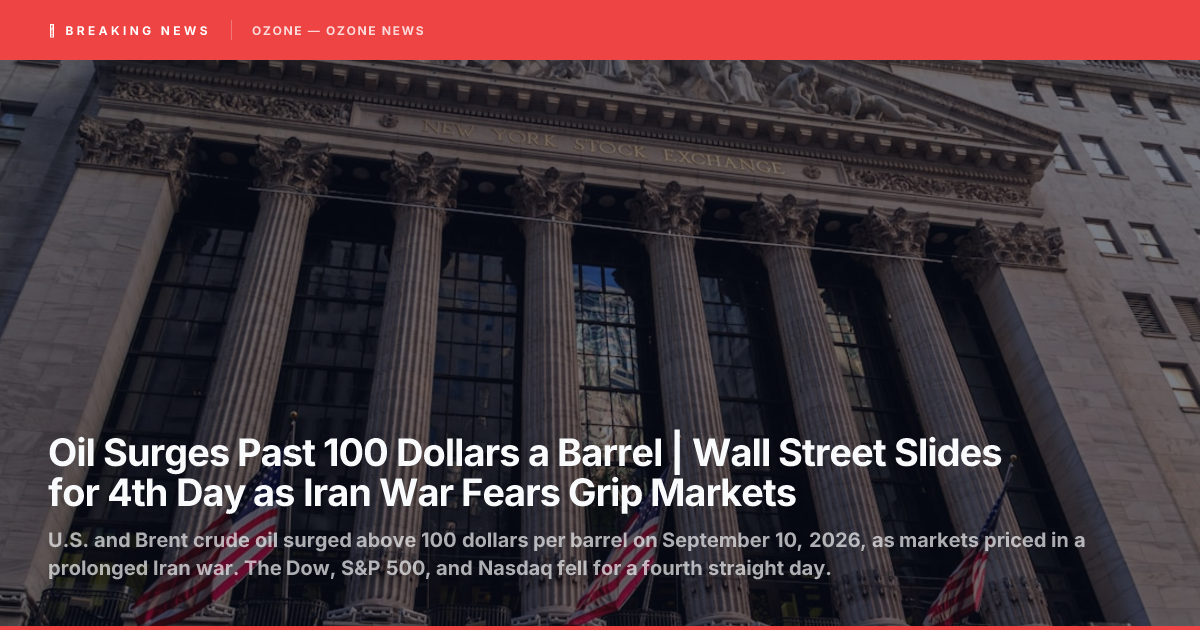
Global energy markets have crossed a critical psychological threshold, sending shockwaves through Wall Street. On Thursday, September 10, both U.S. crude and Brent crude oil surged back above the $100-per-barrel mark for the first time in nearly four months. The spike to triple-digit oil prices was entirely driven by geopolitics. Energy traders are aggressively pricing a severe risk premium into the market as the geopolitical landscape in the Middle East deteriorates. With the market now bracing for a prolonged and deeply destabilizing Iran war, fears of severe supply disruptions in the Persian Gulf have entirely overshadowed recent concerns about weakening global demand. The fallout on Wall Street was immediate and severe. Equities took a heavy beating, with the Dow Jones Industrial Average, the S&P 500, and the Nasdaq Composite all ending firmly in the red. Thursday's close officially marked the fourth consecutive day of losses for the major indices. For broader context on how geopolitical risk affects commodity markets, the Brent-WTI spread and geopolitical risk premium guide covers the mechanics of oil pricing during conflicts.
Inflation Fears and Jumping Treasury Yields
The problem with $100 oil is that it acts as a massive, regressive tax on the broader economy. Energy costs are foundational; when crude spikes, the cost to manufacture, ship, and deliver virtually every consumer good spikes with it. As a direct result of the oil surge, the bond market went into a defensive posture. U.S. Treasury yields jumped significantly on Thursday as traders recognized that sustained $100 oil will almost certainly reignite sticky inflation. If headline inflation begins to climb again due to energy costs, the Federal Reserve will be forced to keep benchmark interest rates elevated for much longer than investors had previously hoped, suffocating the prospects of a near-term economic soft landing. According to CNBC's coverage of the oil surge, the move past $100 marks a significant shift in market sentiment, with traders now pricing in a prolonged conflict scenario that could keep oil elevated well into 2027.
Wall Street Reaction | Four Days of Losses
The equity market reaction was swift and broad. The Dow Jones Industrial Average, S&P 500, and Nasdaq Composite all closed lower on Thursday, marking the fourth straight session of declines. The selling pressure was concentrated in sectors most exposed to energy costs, including airlines, transportation, manufacturing, and consumer discretionary stocks. According to MarketWatch's coverage of the September 10 market close, the S&P 500's energy sector was the only major group to post gains, as oil producers benefited from the higher price environment while the rest of the market sold off. The technology-heavy Nasdaq was particularly hard hit as rising bond yields compressed valuations on growth stocks. For a look at how previous oil shocks have affected equity markets, the Iran war oil trade volatility trap article covers the trading dynamics of earlier phases of the conflict.
The Consumer Impact | Higher Prices at the Pump
For the average American, the Wall Street slide is secondary to the immediate impact at the gas pump. Refineries purchase crude oil weeks in advance, meaning the current surge past $100 a barrel will manifest in higher retail gasoline and diesel prices in the coming weeks. With winter approaching, analysts are also warning of potential spikes in heating oil and natural gas prices if the conflict in the Middle East expands to threaten the broader regional energy infrastructure. According to Reuters' oil market analysis, oil prices are set to end the week above $100 for the first time in nearly four months, with the risk premium likely to persist as long as the Iran conflict remains unresolved. Until the geopolitical risk subsides, the market is bracing for severe, sustained volatility. For consumers looking to manage household budgets during periods of energy price inflation, the 50/30/20 Budget Rule guide covers how to adjust spending when essential costs rise.