
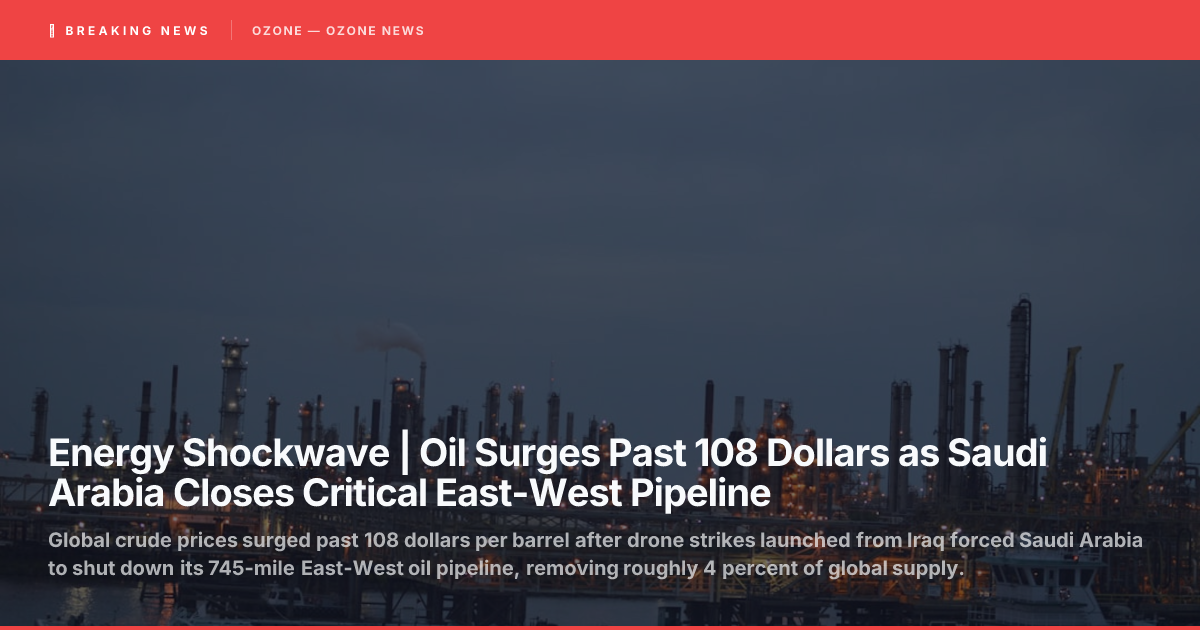
For months, as military conflict across the Persian Gulf functionally shuttered the Strait of Hormuz, global energy markets relied on a single 745-mile logistical conduit: Saudi Arabia's East-West Crude Oil Pipeline. By pumping nearly five million barrels of crude per day from eastern oil fields straight to the Red Sea port of Yanbu, the kingdom managed to bypass maritime chokepoints and keep world supply chains afloat. That vital valve has now been closed. Following a coordinated series of long-range drone strikes targeting pumping stations in the Riyadh and Medina regions, the Saudi Ministry of Energy officially halted operations along the entire East-West corridor as a precautionary measure. The sudden removal of roughly 4 percent of global oil supply sent immediate shockwaves through international commodity markets, pushing Brent crude futures past $108 per barrel and reigniting global inflation fears. For broader context on how the Iran conflict has reshaped oil markets, the Iran War Oil Trade Volatility Trap article covers the trading dynamics of earlier phases of the conflict.
The Attack Anatomy | How Drones Struck the Desert Corridor
According to satellite telemetry and statement logs issued by Saudi Aramco and defense officials, multiple low-altitude uncrewed aerial vehicles struck key electrical substations and compression units adjacent to the 48-inch pipeline infrastructure. Although no direct fatalities were reported at the pumping facilities, structural fires and severe pressure losses forced automated shut-off valves to trigger across the desert network. Preliminary intelligence assessments released by U.S. and regional authorities indicate the strikes originated from proxy militia hubs inside neighboring Iraq. With the main pipeline out of service, the Red Sea export hub at Yanbu has been reduced to relying strictly on local tank farm inventories, a buffer that energy analysts at The Guardian warn will run dry within five to seven days if pumping operations cannot be restored. For a look at how previous oil supply disruptions have affected markets, the Oil Surges Past $100 article covers the earlier phase of the energy crisis.
Market Impact Matrix | The September 2026 Energy Surge
The unexpected pipeline closure triggered immediate price spikes across energy benchmarks, bond markets, and shipping indices. Brent crude surged past $108.50 per barrel while WTI crude topped $103.20. The pipeline had been carrying 4.0 to 5.0 million barrels per day bypassing the Strait of Hormuz. Yanbu's Red Sea terminal storage reserves are estimated at only 5 to 7 days of export capacity. The attack has been attributed to drone launches confirmed by Iraqi authorities originating from domestic militia zones. The macro fallout was immediate, with the U.S. 10-year Treasury yield surging past 5 percent amid a renewed inflation sell-off. According to The Economic Times' market analysis, analysts warn that any extended multi-week outage could push global crude benchmarks toward the $120 threshold, putting immense pressure on Western economies dependent on imported energy.
Macro Fallout | Wall Street and Global Markets React
The timing of the outage could not be worse for central banks attempting to tame stubborn global inflation. Simultaneously driven by new Houthi naval maneuvers near the Bab al-Mandab strait and stalled diplomatic talks in Oman, commodities traders rushed to price in a prolonged supply deficit. On Wall Street, the crude rally triggered a sharp sell-off in sovereign debt, sending the U.S. 10-year Treasury yield above 5.0 percent for the first time since late 2023 as bond traders braced for higher-for-longer interest rates. With Saudi Aramco repair crews working under heavy military escort to assess damage at the struck pump stations, the duration of the outage remains uncertain. For a deeper look at how oil supply shocks affect the broader economy, the How to Trade $100 Oil guide covers trading strategies using USO, XLE, and energy stocks during crude spikes.